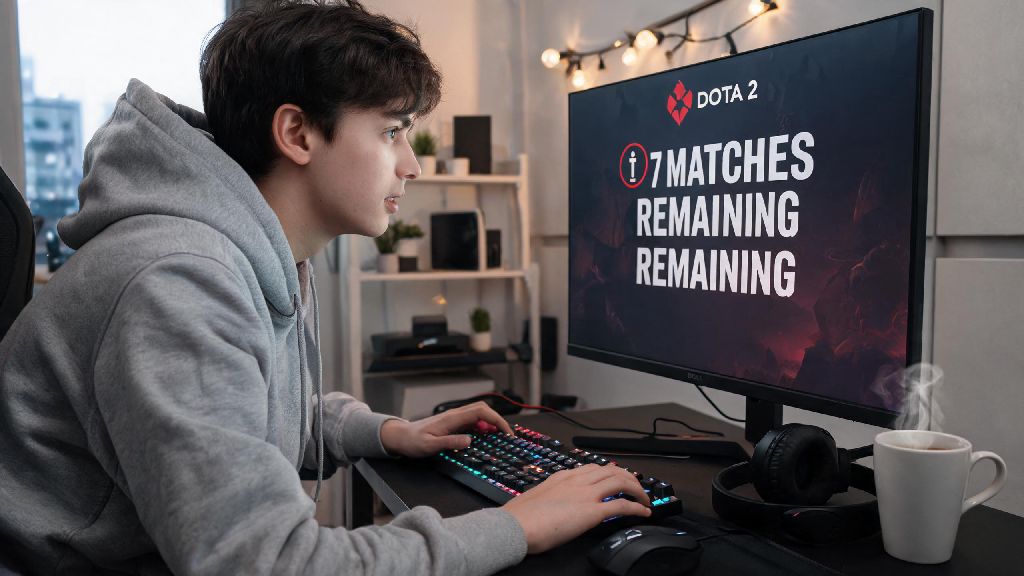
If you’ve come back to Dota 2 in 2026 after a few months away, or you’re jumping into ranked play for the first time, you’ve probably asked yourself how many games to recalibrate dota 2 so you can stop getting matched with players way outside your skill level. I was in the exact same boat back in April 2026, when I logged on after a 7-month break for a work project, only to find my MMR was so stale I was getting paired with Herald players even though I’d been Legend rank before my break. The 2026 ranked system update changed a lot of the old calibration rules, so the answer isn’t the same as it was a few years ago, and there are a few surprises most players don’t know about until they’re already halfway through placement matches.
How Many Games to Recalibrate Dota 2 in 2026
As of the March 2026 ranked system overhaul, the base number of calibration games you need to play to lock in your new MMR is 7 core placement matches. That’s down from 10 matches required in previous years, a change Valve made to cut down on the grind for returning players who don’t want to spend weeks playing placement games just to get back to their correct rank. If you want to adjust your role-specific MMR for positions you play less often, you can opt in to 3 extra role-specific calibration games, but these are completely optional and won’t affect your overall core MMR unless you want them to. If you have an older account with more than 1,000 ranked games played before your break, you might even see your MMR lock in after 6 games, as the system already has a large pool of data to base your skill level on. The only time you’ll need to play more than 7 games is if your performance is extremely inconsistent across your first 7 matches – for example, if you get 10 kills one game and feed 15 deaths the next, the system will ask for 1 or 2 extra games to confirm your actual skill level before locking in your rank.
Factors That Impact How Fast Your Dota 2 Recalibration Finishes
A lot of players assume the 7-game rule is set in stone, but there are a handful of factors that can speed up or slow down your calibration process in 2026. I learned this first hand when I got my final MMR after only 6 games, because I stuck to my main offlane role and had consistent stats across all my placement matches. The biggest factors that affect your calibration length are:
If you want to check the full breakdown of how the calibration algorithm weights these factors, you can look through Valve's official 2026 ranked update notes for the exact math they use. I won’t bore you with all the formulas here, but the key takeaway is that consistency matters far more than just winning every game when it comes to fast, accurate calibration.
Common Myths About 2026 Dota 2 Recalibration You Should Ignore
There’s a lot of bad advice floating around Reddit and Discord about how recalibration works in 2026, and a lot of it leads players to make mistakes that mess up their final MMR. One of the most common myths I see is that you have to win all 7 placement games to get a higher rank than you had before your break. That’s not true at all – the system weights individual performance far more than win/loss, especially if you’re playing with a premade that’s much higher or lower skill than you. I won 3 of my 6 calibration games and still got back to my original Legend 3 rank, because I had top stats in every match I played. Another big myth is that recalibration completely resets your MMR to zero. Your previous rank is always the baseline for your new MMR, so even if you lose all 7 games, you won’t drop more than 1,000 MMR from your pre-break rank unless you’re playing drastically worse than you used to. You can also opt out of recalibration entirely if you’re happy with your current MMR – you don’t have to go through the process unless you want to adjust your rank to match your current skill level. The only time you’re forced to recalibrate is if you haven’t played a ranked game in 6 months or more, or if Valve rolls out a major system update like the 2026 overhaul.
Actionable Tips to Get an Accurate MMR During 2026 Calibration
Now that you know how the system works, there are a few simple things you can do to make sure you get the rank you actually deserve, instead of getting stuck in a lower bracket because of avoidable mistakes. First, warm up with 2 or 3 unranked games before playing any calibration matches. I made the mistake of jumping straight into my first placement game right after logging back in after 7 months, and I fed 12 deaths because I’d forgotten how to last hit under pressure. That one bad game didn’t ruin my calibration, but it did add an extra layer of uncertainty the system had to adjust for. Second, stick to your main roles and heroes you’ve spent hundreds of hours on. Don’t try out that new offlane hero you saw a pro play in the recent Dota Pro Circuit 2026 matches, even if it looks overpowered – you’ll just add unnecessary variance to your matches. Third, don’t play calibration games if you’re tired, tilted, or distracted. It’s easy to blame the system for a bad rank, but half the time players end up lower than they deserve because they played 4 placement games in a row at 2 a.m. after a long day at work. If you lose two games in a row, step away for a few hours – coming back refreshed will make a way bigger difference than grinding through tilt to get your calibration done faster. Fourth, if you’re playing with a party, make sure their MMR is within 300 points of your pre-break rank. If you queue with a friend who’s 1,000 MMR higher than you, the system will assume they’re carrying you, so you’ll get way less MMR for wins even if you played just as well as they did. I learned this the hard way when I queued with my Immortal friend for my first two calibration games, and I got almost no MMR gain for both wins, even though I had the most hero damage on my team both games.
At the end of the day, how many games to recalibrate dota 2 in 2026 will usually land between 6 and 9 matches, with 7 being the standard for most players. Don’t stress too much if you don’t get the exact rank you want right after calibration – it’s just a starting point, and you can always climb or fall as you play more ranked games after the process is done. I was worried I’d drop all the way to Archon after my long break, but I ended up right back at my old rank after just 6 games, and I’ve already climbed 200 MMR since then. Just focus on playing consistently, sticking to your strengths, and not letting tilt get to you, and you’ll end up with a rank that matches your actual skill in no time.